

Lenovo C730 Cube deep dive: A solid budget option for mainstream gamers - murphysuitessay
The "C" in C730 stands for "Cube." That's whol you really need to know about Lenovo's C730 Cube mini-PC. It's bantam, information technology's boxy, and separate of adorable. It's also surprisingly powerful, at least coming from Lenovo—a company I don't typically expect to anaesthetise great play PCs.
Lenovo's made a agitate these past a couple of eld though, first in laptops and now desktops. The goal: Mainstream gaming hardware at a mainstream (read: affordable) price point. The C730 International Relations and Security Network't needs the "nigh" anything—not the about powerful, nor the just about compact, nor the most elegant. But IT's enough of each to make it worth a bit look, specially for space- and budget-conscious shoppers.
Lenovo Legion C730 Cube design: Outside the box
 Adam Patrick George Gilbert Aime Murphy/IDG
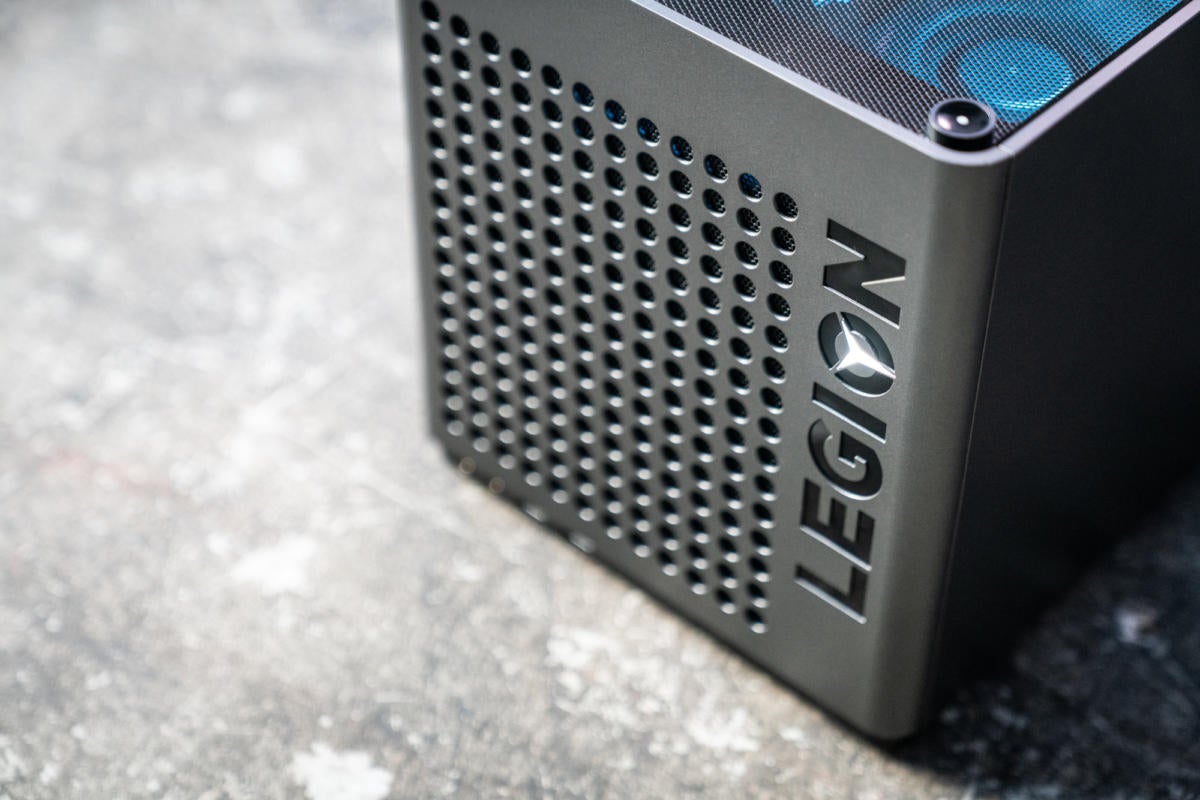
 The Lenovo C730 Third power's distinctive front dialog box sports an array of circular ventilation holes on the grille.
The C730 Cube isn't as tiny every bit some of its console-esque brethren, like the MSI Trident 3 or the Asus ROG GR8. Measuring 9 inches tall, 9 inches wide, and 13 inches deep, however, IT's still a far cry from a tower. It's pretty damned portable as well, coming in subordinate 20 pounds.
Did I mention there's a handle? It's the second feature you notice, after the diminutive size. Many different gaming PCs sport a handle, of course, but the C730 Regular hexahedron is one of the few small enough for a do by to make sense.
At E3 I joked that the C730 was "like the GameCube," chiefly because of the handle. The more I've thought about information technology, the much I like the comparing to Nintendo's old cabinet. Information technology's fitting. As is then frequently the case with Nintendo, the GameCube deviated from established console norms of the time to create a soothe with mainstream appeal. I get the synoptical vibe from Lenovo here. Purpose is subjective, of run, simply it has more flair than your standard initiative-focused desktop, without leaning al dente into the gaming aesthetic either. The front panel's circular grille pattern is unique and far Thomas More friendly than the hard edges we'd typically see in gambling pre-builts.
 Adam Patrick Murray/IDG
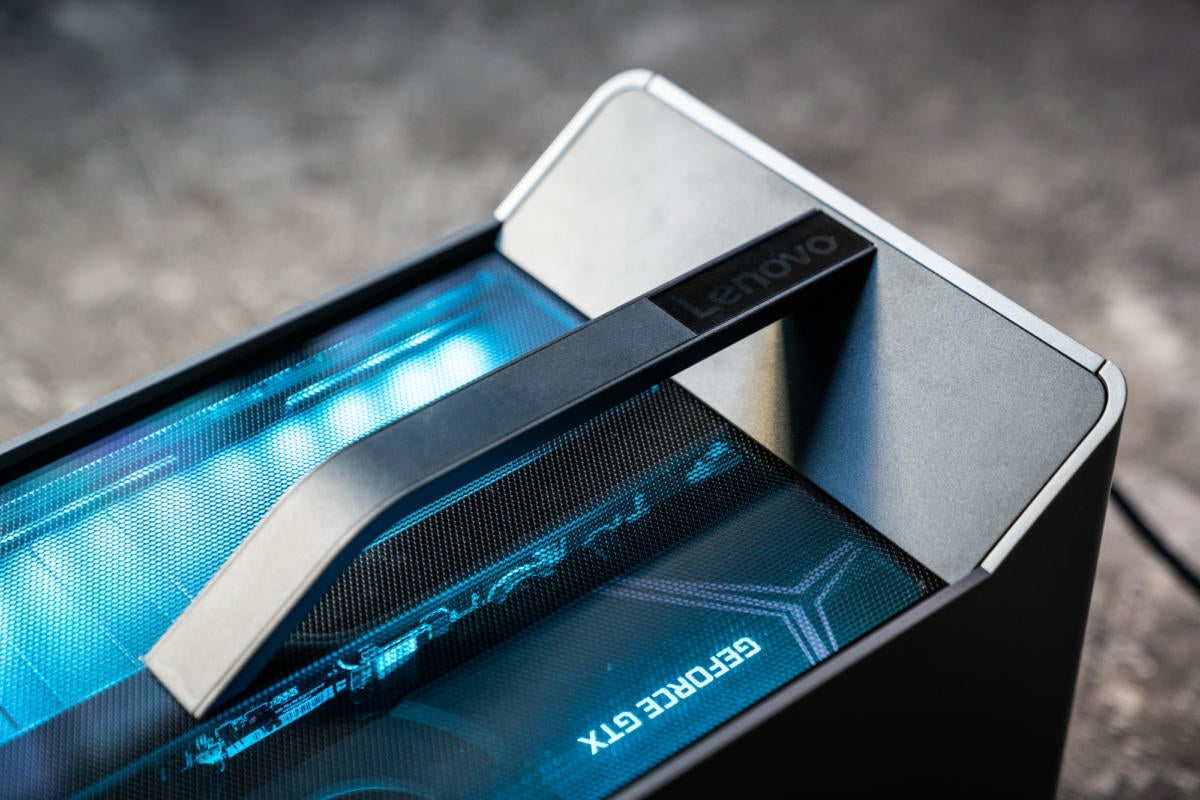
 You can savour the RGB kindling through the top impanel of the Lenovo Legion C730 Cube.
So yeah, in sweeping swathes I erotic love the seem of the C730. I'm flatbottom a fan of the logo, which is good because it takes upwardly a large percentage of the front dialog box. Lenovo wisely keeps its own branding tasteful, allowing the "Legion" sub-make to dominate the design. IT's a pretty generic name, but I like the typeface put-upon here, as well as the backlit starburst design on the O, which gives it about a 60's retro-futurist, blank space-station look.
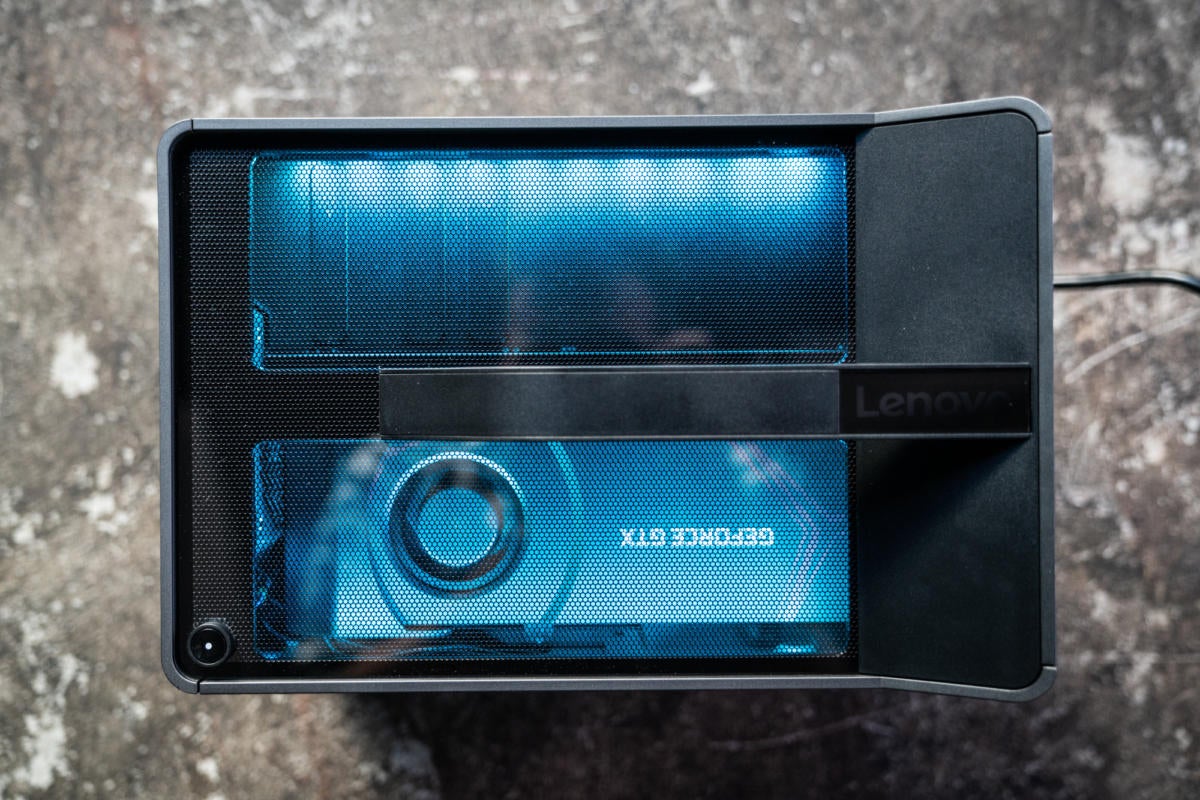
The all-but-mandatory RGB lighting touches are also comfortably cooked. You get the barest hint of light-headed through the circular openings on the movement panel, positive a couple of highlights on the back. The sides are opaque, and the primary firing geographical zone is actually the top—a translucent panel that shows forth the C730's indoor light too as the GPU.
It's a piece loud for parlour habituate perhaps, an accusation I've likewise leveled at the MSI Trident in the past. But by angling the kindling ascending instead of outward, it at least prevents the C730 from blinding you in a dark elbow room—plus, the lawsuit is short enough you can in reality occupy a peek inside.
 Hug dru Patrick Sir James Murray/IDG
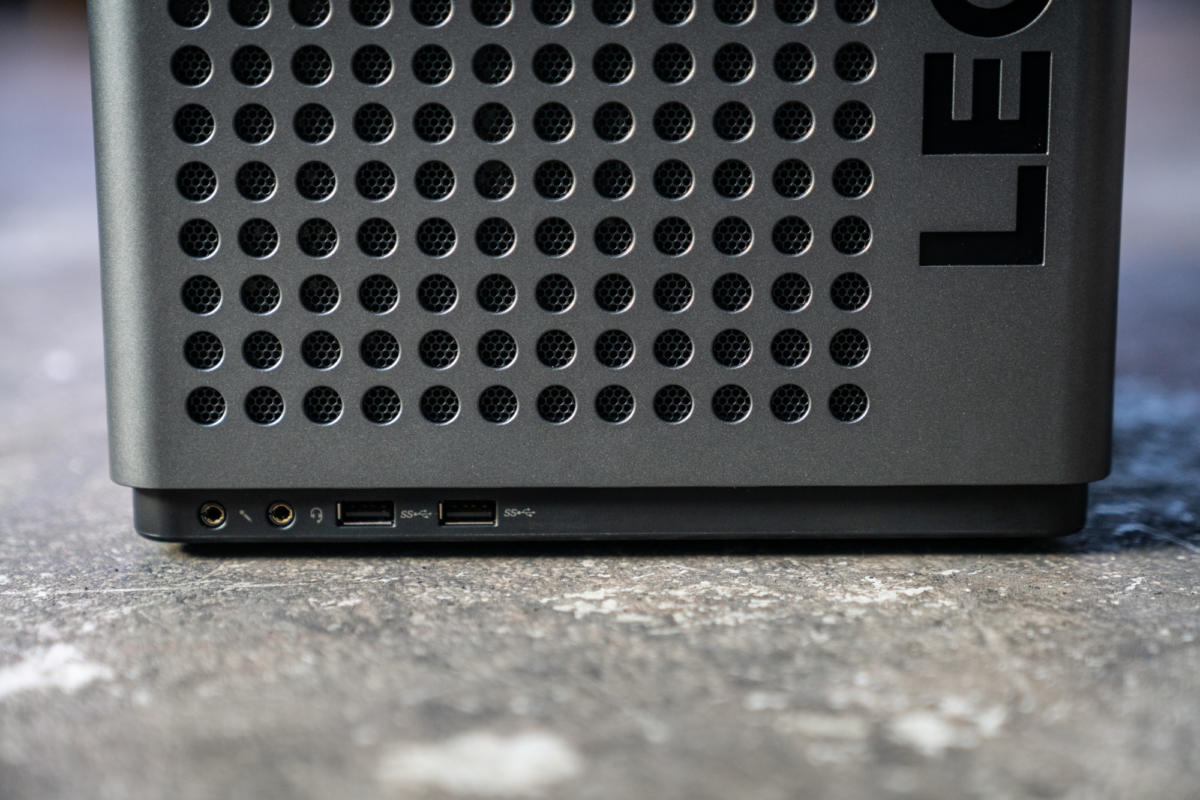
 The small assemblage of ports on the bottom of the face panel are frustratingly difficult to access.
I do have a few projected points. The front I/O is crammed in at the hindquarters of the eccentric, which is a terrible decision. Either you confine the C730 Cube to desktop use, or you're never going to use those nominal head ports. There's nary way you're departure to run wires all the direction to these ports if the PC is on the floor, especially headphones and mike cables. Even much bizarre: The two USB-A ports are top-down, and given only a half-edge in or so of clearance. I couldn't even manage to set a handful of USB sticks I had untruthful around, which is awfully inconvenient for in advance panel connections.
There's also a pencil eraser cable wrangler on the rear. This one's less actively annoying, more just pointless. It sits right at the bottom of the rear I/O, which implies you're supposed to run cables out the hinder and…down? Even if you perch the C730 Cube along a desk, it doesn't make more than horse sense to run the cables underneath the rubber trounc and then back up to your peripherals, and if you intend to sit the C730 on a blow out of the water IT's an fifty-fifty much futile feature.
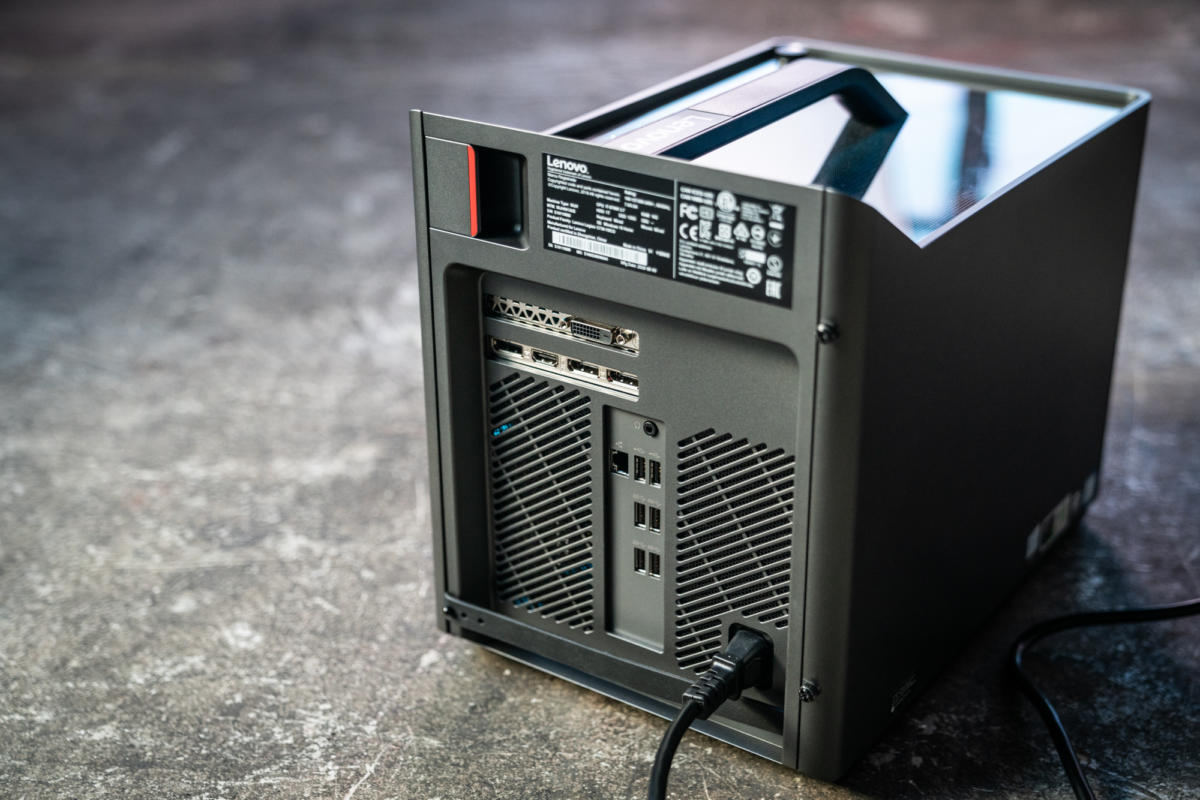
I'd also be remiss if I didn't mention the dismal number of ports on the C730. It's a congested-size graphics plug-in, which at least agency a full full complement of DVI-D, HDMI, and cardinal DisplayPort jacks. Aside from that however, the keister panel features only a dual headphones/microphone 3.5mm port (as anti to the split 3.5mm ports connected the front), ethernet, cardinal USB 3.1, and 2 USB 2.0 ports.
 Adam Patrick Murray/IDG
 The Lenovo C730 Square block's rear panel has fewer ports than we'd like to see happening a gaming Microcomputer.
In this day and age, and peculiarly as a gamer, eight USB ports is surprisingly not that many—particularly if you happen to own an Oculus Falling ou, which will cannibalize 3 Oregon 4 of those ports on its own. I deliver 14 on my daily PC and receive had to juggle USB slots before, between my headset, mouse, keyboard, speakers, audio interface, VR headset, and et cetera.
Maybe it's not a problem for you. Or maybe you dismiss minimize the problem with a USB hub—although hold open in mind USB slots are all fed through a smattering of USB buses, so adding Sir Thomas More ports might nonetheless cause conflicts if you suffer very much of information-heavy devices (i.e. VR headsets, which take up a lot of USB bandwidth).
Inside the box seat: Horde C730 Cube specs and features
The C730 Cube is actually the pricier of Lenovo's two cube-shaped models. There's a C530 below it, which in many respects is the same box—leave out it ships sans RGB firing, and with lower specs.
So for the sake of covering the whole spectrum, allow's start with the C530, whose list Mary Leontyne Pric of $880 includes:
- CPU: Intel Core i5-8400
- GPU: Nvidia GeForce GTX 1050 Titanium with 4GB of VRAM
- Memory: 8GB of DDR4 Jampack
- Storage: 1TB hard drive
- Networking: 802.11ac WI-Fi adapter and Bluetooth 4.2
Lenovo's top-tier C730 Cube lists for $1,520 and includes:
- CPU: Intel Core i7-8700
- GPU: Nividie GeForce GTX 1060 with 6GB of VRAM
- Memory: 16GB of DDR4 RAM
- Storage: Dual 1TB HDD/128GB SSD
- Networking: 802.11ac Wi-Fi arranger and Bluetooth 4.2
That's a solid state mid-grade gaming background, with operation to agree. At list price, I'd say it's a bit more expensive than I'd like. Before the MSI Trident 3 disappeared from Amazon information technology sold-out for around $1,200—and included a GTX 1070, non a GTX 1060, as Lenovo's done hither.
But as is thus often the subject, list price is merely a suggestion. Lenovo itself sells the system we received for about $1,200 (at time of writing). That's a nice deal, peculiarly in the post-GPU inflation era. You could potentially chassis your own for cheaper, but you'd belik end raised with a larger and less elegant human body element, no RGB lighting, nobelium Wisconsin-Fi or Bluetooth, and still only save $100 roughly. The same goes for otherwise pre-built PCs.
 Robert Adam Patrick Murray/IDG
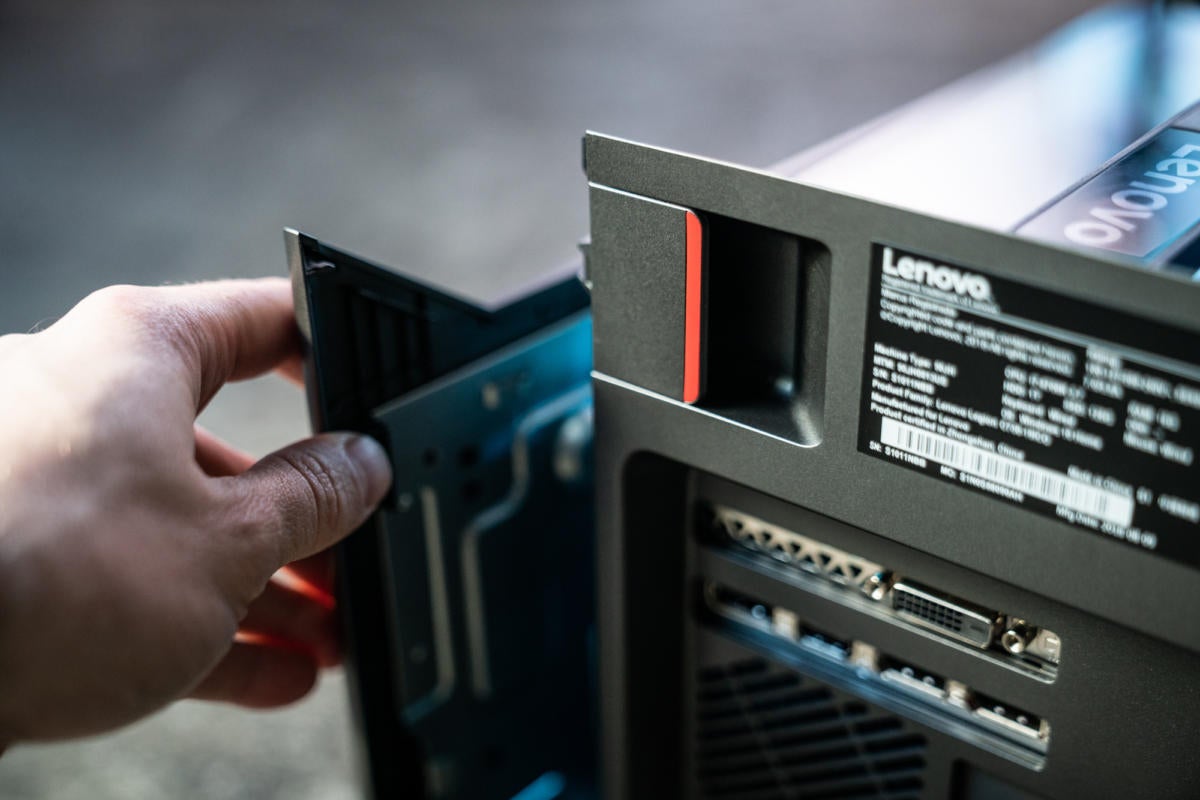
 The rightish panel of the Lenovo C730 Cube releases easily using a lift latch.
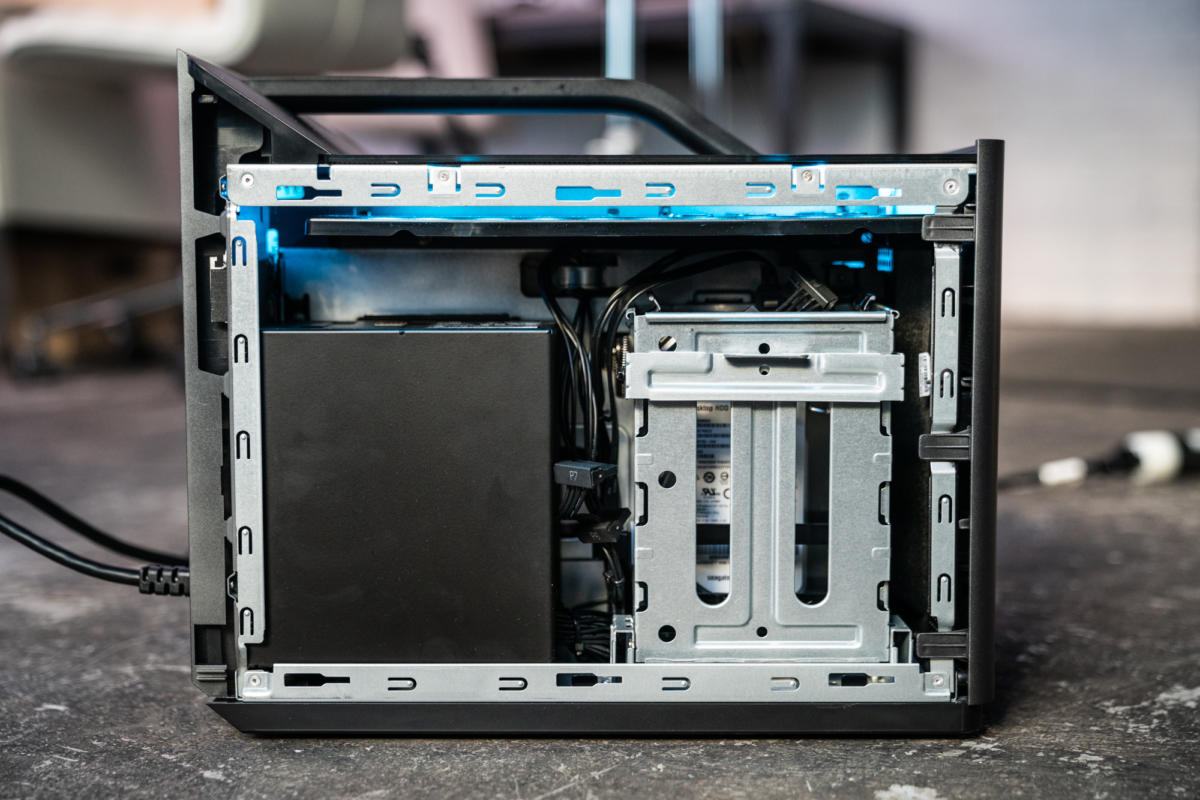
The C730 is also properly upgradable, which isn't forever a guarantee with these bespoke mini-PCs. The interior is well accessed by pulling a prize happening the rear panel, which lets you slide off the appropriate side. That gives you access to the GPU, Central processor, and RAM, as well American Samoa most of the motherboard cabling. Thumbscrews stormproof the left venire, which houses the power supply and the hard labour rack.
How information technology completely comes in concert
A PC give notice look good theoretically, only what really matters in the end is how it's all together. In the case of the Lenovo Legion C730 Cube, at that place's some good and roughly bad.
 Adam Patrick Murray/IDG
 The transparent pinnacle panel of the Lenovo Legion C730 Block shows sour RGB firing and the GPU hide.
First, the good. The C730 uses a full-distance (meaning 9.6-inch) GPU, which means you should be set to upgrade to any identity card in the foreseeable future. Another mini-PCs, like the MSI Trident, use the shorter 6-inch GPUs, which are a spot more limited when it comes to upgrading.
It also uses what looks like a standard power provide. That's tremendous. Much of these mini-PCs purpose a custom business leader solution (like the MSI Trident's external brick). But if you want more than power in your C730? I didn't break up our uncastrated scheme, but it looks like you could side out the old 450W supplying and replace it with a more powerful one.
 Adam St. Patrick Murray/IDG
 The Lenovo C730 Cube's left panel opens to reveal the power render (left) and drive bays (right).
Some caveats: Swapping come out of the closet the PSU would probably be a huge hassle, and there's no place along the C730's case for the classical bottom-facing PSU devotee to vent. A more powerful PSU usually agency more heat, and you might have trouble oneself blown sufficiency air to keep it cool.
That said, you've got a fleck of headroom plane if you don't climb the power supply. A 450W PSU is sufficiency to run a Kernel i7-8700 (operating theatre stock 8700K) and a GTX 1070 Ti with whatever way to spare. In fact, we saw a C730 moving a GTX 1070 Ti at E3, though we were told it wasn't a "certified" setup. Evidently Lenovo didn't fetch up marketing it. Non sure why, because per the raw numbers it seems perfectly capable. You couldn't slap a 1080 Ti in the C730 without throttling it. But you could probably make a lateral pull in a few years to the GTX 1470 or 4070, or whatever 2022's equivalent might be named.
O.k., now the hopeless.
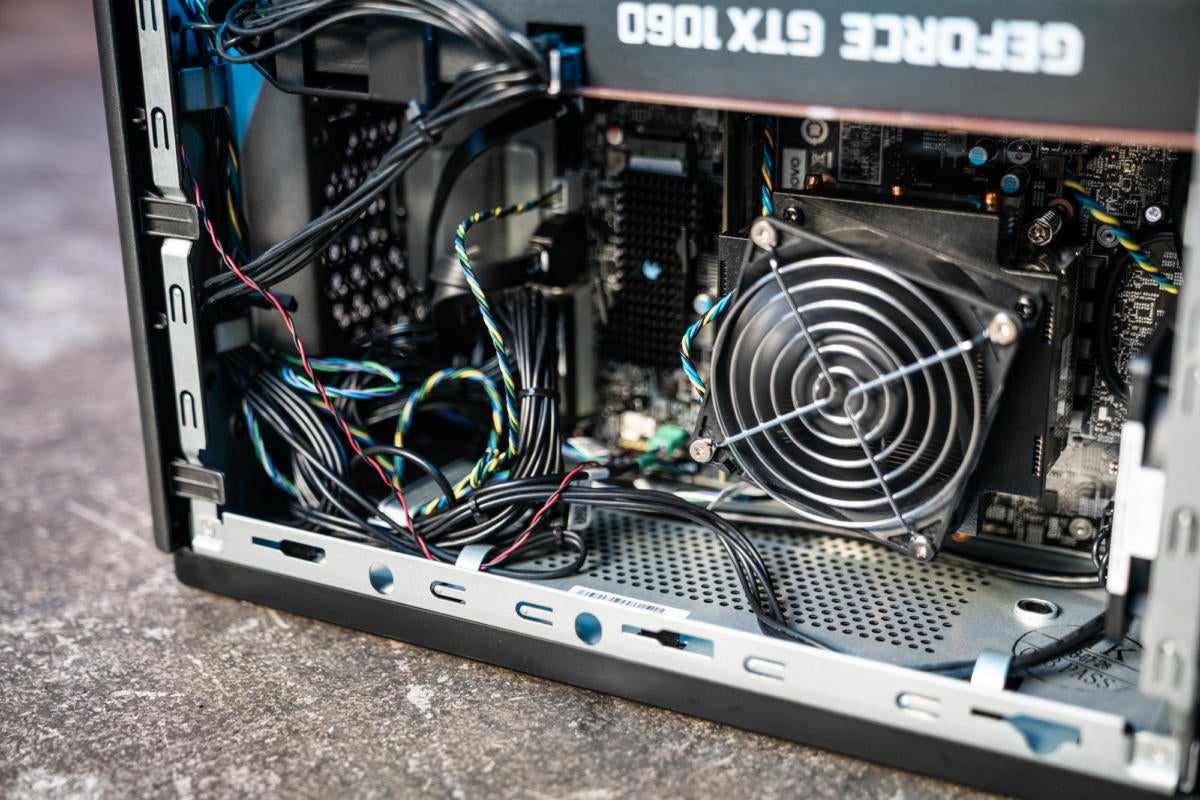
Firstborn and foremost, cable management is atrocious. Pioneer the C730, and it looks a caboodle uglier than it does on the away. There are dozens of thin, fastidious cables squirting between all the different parts, with a especially bad eyesore bunch draw close the front. And look, I get information technology: There isn't much room to hide the cables in this tiny box. Unmoving, it could depend tidier.
 Adam Patrick Murray/IDG
 Yes, the Lenovo C730 Cube is cramped for space interior, only the quite a little of cables still surprised and disappointed us.
IT also looks like a real painful sensation to upgrade the RAM. There's no heat-broadcaster on the single 16GB stick in our system, and I don't flush think the C730 could handle a heat-spreader. The RAM is completely-but-touching the CPU cooler on one side. 16GB should be enough for the lifespan of the C730, but it's still worth noting.
There's non much cooling, equally I half-mentioned above. There's what looks like a single 80mm fan exhaust against the rear panel, with no intake fans of whatever kind (unless you count the GPU and CPU fans). I said earlier that you could get a Core i7-8700 or 8700K for the equal price, the K indicating a processor that can be overclocked. On the one bridge player you might also get the K so you have the option to overclock, but on the other? I crapper't gues you could do much, because I suspect even out a slight overclock would movement the system to overheat. There are no evident places to add fans, either, at least without dismantling the intact system.
 Adam Patrick Murray/IDG
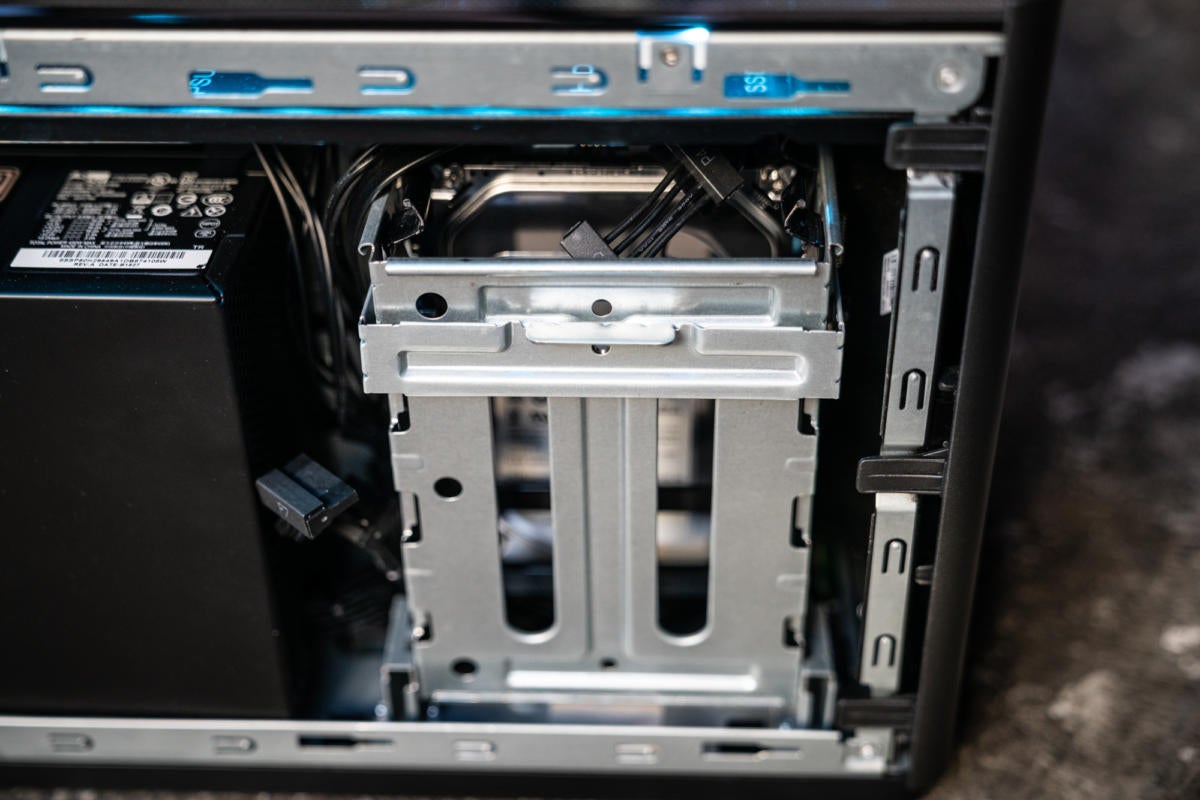
 The beat back bay carriage in the Lenovo C730 Cube is awkward to deal with: vertically homeward-bound, and complex to maneuver.
Finally, the disk drive rack is awkward to deal with. Information technology's panoplied vertically, and you pull a lever and sort-of…fold the hale enclosure out of the causa. You replace it with a loud clang that startled me the first time. There are hookups for a few additional drives, though it's probably easiest to swap out the 1TB drive for a much larger drive upon arrival, if you have the foresightedness.
I would've likeable to see the drive space upgraded across the board, in reality. A 128GB SSD is paltry therein day and age, especially with prices as low-level as they've been recently.
Bottom line
Gripes digression, I'm tranquil impressed overall. Hear, the Legion C730 Cube isn't for "Grave PC Gamers" Beaver State whatever, that group (and I include myself in this) that's always chasing smoother frame rates, quieter fans, better textures. But the Steam Hardware Survey indicates the GTX 1060 is the single nearly popular card among gamers these days, and that more 50 percent of Steam clean users run a 1060, a 1060-equivalent, or lower.
That makes the C730 a solid option for the mainstream gamer on a budget. It's got an eye-catching design, a comparatively easy way to upgrade, it's placidity(ish) and inconspicuous(ish), powerful sufficiency to swordplay modern games at High settings (on a 1080p monitor at least), and it does it all for cheap.
That was enough for Lenovo to pretend a dent in the gaming laptop grocery store. Maybe it's enough to make a dent in the gaming desktop market as well.

Source: https://www.pcworld.com/article/403198/lenovo-legion-c730-cube-hands-on.html
Posted by: murphysuitessay.blogspot.com
0 Response to "Lenovo C730 Cube deep dive: A solid budget option for mainstream gamers - murphysuitessay"
Post a Comment